End-to-End Encrypted Push Notifications Explained
The Illusion of Security in Standard Push
In the B2B SaaS ecosystem, “security in transit” is the baseline, but it is often misinterpreted as absolute privacy. Standard push notification architectures—specifically those relying on Firebase Cloud Messaging (FCM) and Apple Push Notification service (APNs)—utilize Transport Layer Security (TLS) to protect data moving from your server to their gateways. However, once the notification reaches the gateway, it is decrypted and re-encrypted. This means the infrastructure provider (Google or Apple) technically has access to the plaintext content of your notifications.
For industries like fintech, healthcare, or legal-tech, this “middleman” access is a compliance liability. End-to-End Encryption (E2EE) for push notifications removes the provider from the trust equation entirely.
The Technical Architecture of E2EE Push
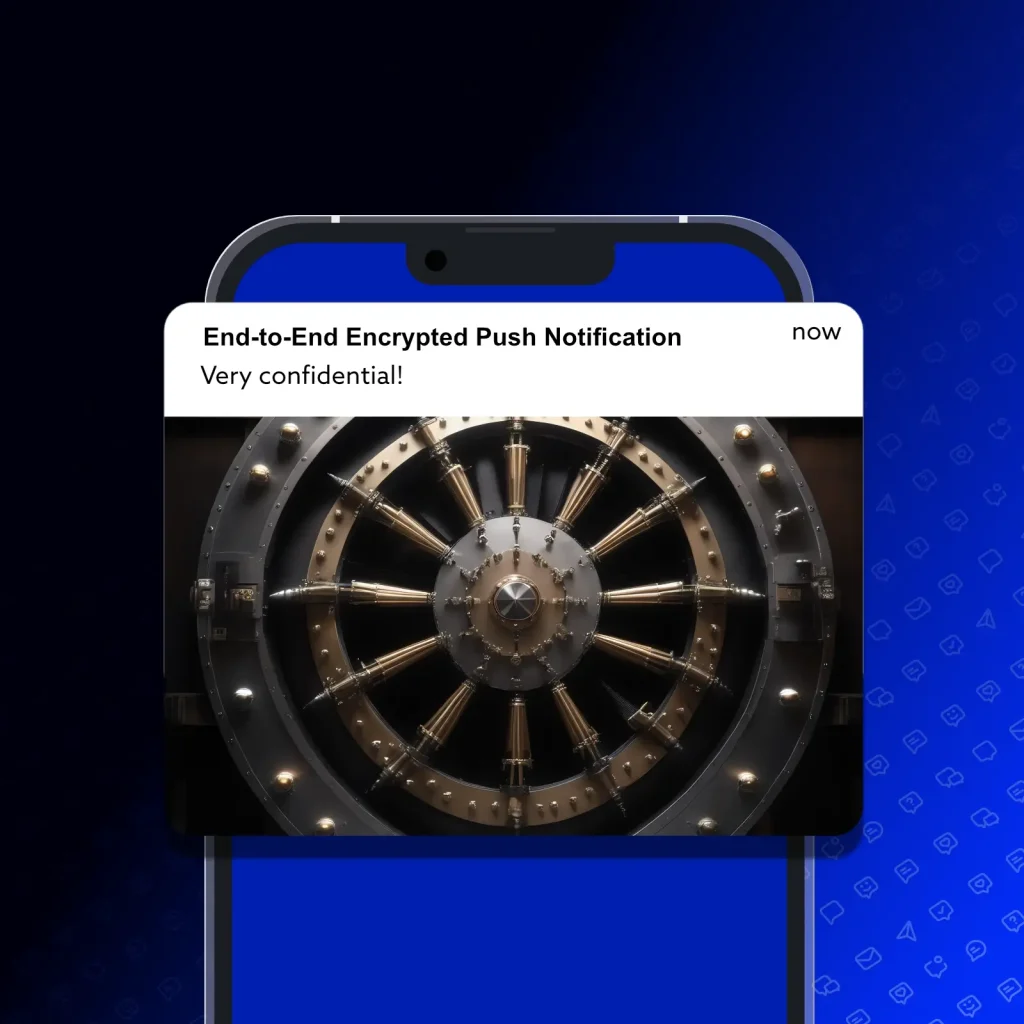
E2EE ensures that the notification payload is encrypted on your application server and remains ciphertext throughout its entire journey, including while sitting on the OS provider’s servers. Decryption occurs strictly on the end-user’s device.
The mathematical foundation often relies on Asymmetric Encryption (RSA or Elliptic Curve Cryptography). In a simplified model:
- The Client Device generates a key pair: a Public Key and a Private Key.
- The Public Key is sent to your App Server
- When sending a notification, the server encrypts the message using the Public Key.
- The ciphertext ($C$) is sent through Push0/FCM/APNs.
- The Client App receives ciphertext and decrypts it using the local Private Key:
Implementation: Notification Service Extensions (iOS) and Data Messages (Android)
To display these messages, developers must use specific system hooks. On iOS, this is the UNNotificationServiceExtension. When an encrypted push arrives, the OS gives the extension a few seconds to intercept the ciphertext, decrypt it in a secure sandbox, and replace the content before the user sees the alert. On Android, Data Messages are used to wake the app in the background, allowing the app’s logic to handle decryption before posting a local notification.
Comparison of Notification Architectures (2026)
| Feature | Standard FCM/APNs | Custom E2EE (Push0) |
| Data Visibility | Provider can read plaintext | Provider sees only ciphertext |
| Compliance | GDPR/HIPAA “at risk” | Zero-knowledge compliance |
| Complexity | Low | Moderate (Key management) |
| Latency | Minimal | ~50-100ms (Decryption overhead) |
| Metadata Security | Headers visible to provider | Headers visible; Payload opaque |
The Business Verdict
If your SaaS handles sensitive PII (Personally Identifiable Information), relying on standard OS delivery is a gamble. E2EE is not just a feature; it is a defensive architecture that protects you from subpoenas, data breaches at the provider level, and regulatory fines.
Like what you’re reading?
Push0 is a privacy-first push notification service built for devs and marketers who care.
Try it free for 14 days — no credit card, no fluff.